

Written by: ASTI Academy | Updated: 3 November 2026 | 10 min read
Quick answer
UK qualification levels show how demanding a qualification is, not how long it takes. Level 3 sits at the same stage as A levels, Level 4 at the first year of a UK university and Level 5 at the second year. In the UAE, most students start at Level 3 without Grade 12, or Level 4 with it.
If you’ve been comparing courses in Dubai, you’ve seen labels built on UK qualification levels again and again: “Level 3 Foundation”, “Level 4 Diploma”, “Level 5 Higher International Diploma”. They sound official, and they are. But hardly anyone stops to explain what the numbers mean, or which one you should be looking at.
That gap causes real problems. Students sign up for the wrong level and repeat work they didn’t need to. Parents ask whether a Level 5 is “a degree” and get a different answer from every institute. Working professionals with years of experience assume they have to start at the bottom.
This guide explains Levels 3 to 5 in plain terms. It covers what each level is comparable to, who it’s built for, how long it usually takes, and how far it can take you in the UAE. By the end, you should know which level to start at, and which questions to ask before you enrol anywhere.
What do UK qualification levels actually mean?
UK qualification levels place every regulated qualification on one scale, from entry level to Level 8. The number tells you how demanding the learning is, not how long the course lasts. Two qualifications at the same level ask for a similar depth of knowledge and independence, even if one is a diploma and the other is part of a degree.
The scale is used in England and Northern Ireland, and regulated qualifications are listed on a public register you can search yourself (more on that below). That’s useful in the UAE, where you’ll meet qualifications from many different systems. A level number gives you a fixed point to compare against.
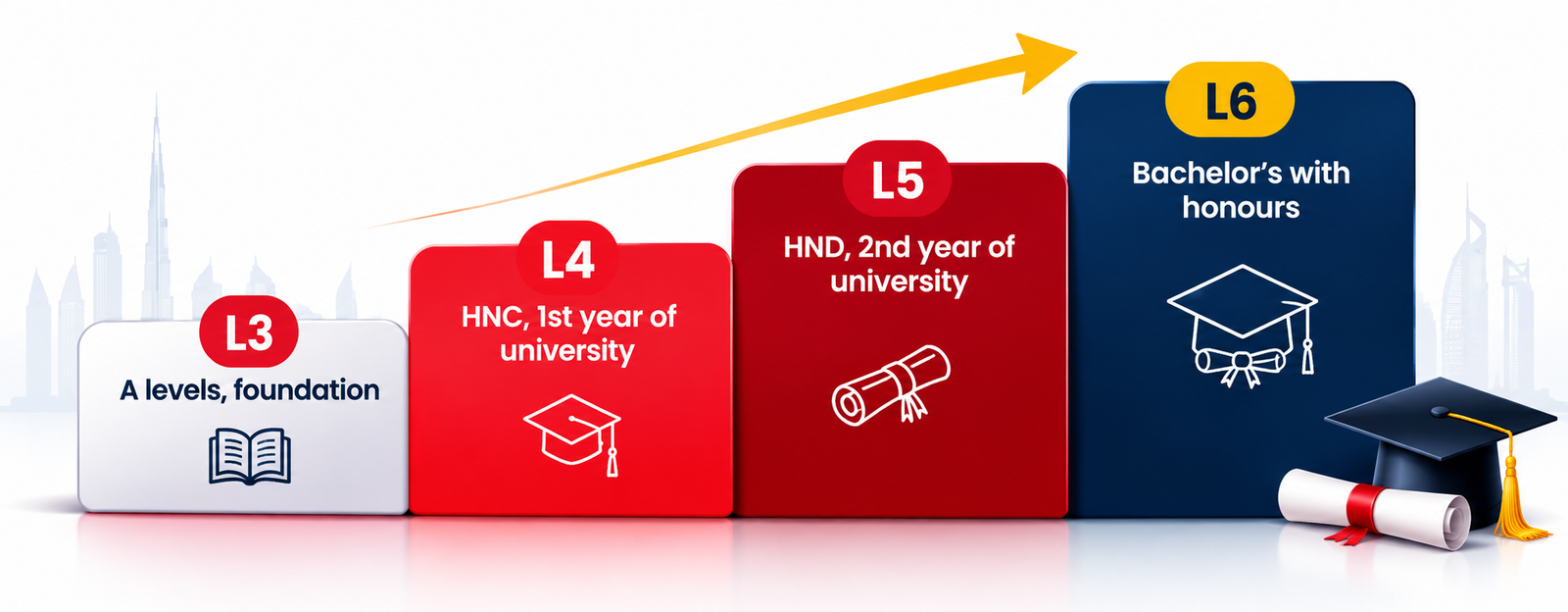
Here’s where Levels 3 to 6 sit, using the UK government’s own examples:
| Level | UK qualifications at the same level | Where UAE students usually meet it |
| 3 | A levels, T Levels, advanced apprenticeships, Level 3 diplomas | Foundation programs, often for students without a completed Grade 12 |
| 4 | Certificate of Higher Education, Higher National Certificate (HNC) | The first stage of a Higher International Diploma, usually after Grade 12 |
| 5 | Diploma of Higher Education, foundation degree, Higher National Diploma (HND) | Completing a Higher International Diploma |
| 6 | Bachelor’s degree with honours | A university top-up year after Level 5 |
“Same level” means same difficulty. It doesn’t mean the qualifications are interchangeable, and it doesn’t decide how a UAE employer or authority will treat them. Keep that distinction in mind, because it comes up again below.
What is a Level 3 diploma, and who is it for?
A Level 3 diploma is a qualification at the same stage as A levels. In the UAE, it’s most often taken as a foundation program by students who haven’t completed Grade 12, or who hold Grade 11 or O Level results. It gives them a structured route into higher-level study.
At ASTI Academy, Level 3 Foundation programs run in engineering, business, hospitality and tourism, and accountancy, on campus or online. They’re much shorter than a diploma, around six months up to 1 year. A foundation program does three jobs at once: it builds the subject basics, teaches the study skills higher levels expect, and opens the door to Level 4.
That last part matters. Level 3 isn’t a lesser option. It’s the level directly below Level 4, so finishing it puts you where a school leaver with Grade 12 would start. See the Level 3 Foundation programs in Dubai for the subjects on offer.
What do Level 4 and Level 5 diplomas cover?
Level 4 and Level 5 diplomas match the depth of the first and second years of a UK university course. Level 4 builds core theory and technical skills in one field. Level 5 moves on to analysis, problem-solving and independent project work. At ASTI Academy, the two are studied together as one Higher International Diploma.
ASTI’s Level 4 and 5 Higher International Diplomas typically run for about two years and carry 240 credits. Fields include:
- civil, mechanical, electrical, automobile and architectural engineering
- quantity surveying
- business management
- accounting and finance
- IT
- psychology
- health and social care
- education and training
- hospitality
Entry is usually straightforward. You need to be 18 or over, hold a recognised high school certificate such as Grade 12, O Levels or A Levels, and meet a basic English requirement. Working professionals can ask about Recognition of Prior Learning (RPL), which is reviewed case by case.

Level 4 or Level 5: where should you start?
Most students in the UAE start at Level 4 if they’ve completed Grade 12, and at Level 3 if they haven’t. You don’t normally choose between Level 4 and Level 5, because a Higher International Diploma takes you through both. Starting directly at Level 5 usually depends on prior study or experience, assessed individually.
Find the row that matches you:
| Your situation | Typical starting point |
| Didn’t complete Grade 12, or hold Grade 11 or O Level results | Level 3 Foundation |
| Completed Grade 12, A Levels or equivalent | Level 4 and 5 Higher International Diploma |
| Already hold a relevant Level 4 qualification | Level 5, subject to review [VERIFY] |
| Years of relevant work experience, few formal qualifications | RPL review to agree the right entry point |
| Need one practical skill quickly | Professional certification (3–9 months, not a UK-level qualification) |
That last row deserves a note. ASTI’s professional certifications in areas such as AI, cybersecurity, HVAC and welding are practical and focused, but they sit outside the UK level system. They’re a good fit when you need a skill for your current job, and a weaker fit when you need a recognised level for progression.
Is a UK Level 5 diploma the same as a degree?
No. A UK Level 5 diploma is at the same level as the first two years of a bachelor’s degree, but it isn’t a degree. Many students use it as a stepping stone: a university can admit Level 5 holders to its final top-up year, and that university then awards the degree.
ASTI Academy delivers the diploma stage; it doesn’t award degrees. Each university sets its own rules on which diplomas it accepts for top-up entry, in the UAE or abroad. So check the university route early rather than after you graduate. Our guide to the diploma-to-degree pathway in the UAE explains how the top-up year works.
Are UK diplomas recognised in the UAE?
Recognition in the UAE depends on what you need the qualification for. Private-sector employers usually assess qualifications themselves. Government jobs, some regulated professions, and some further-study applications may ask for attestation or an equivalency certificate from the Ministry of Higher Education and Scientific Research (MoHESR).
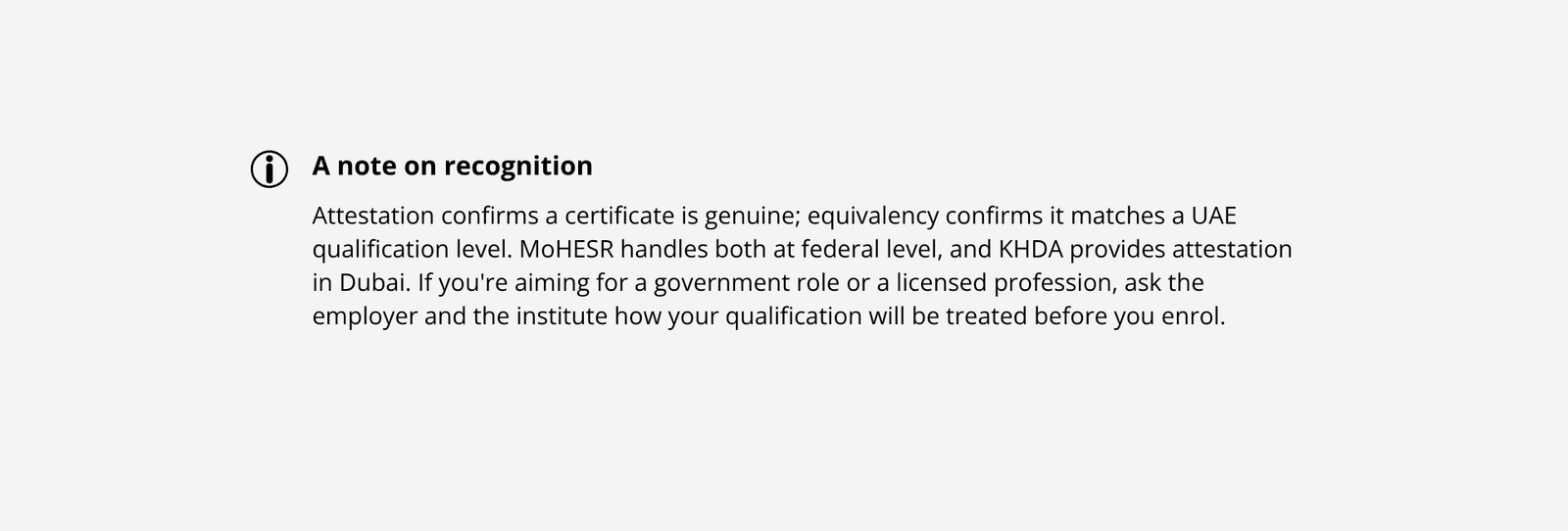
Two quick checks help:
- Confirm the institute is licensed. ASTI Academy is permitted by Dubai’s Knowledge and Human Development Authority (KHDA, Permit 60033).
- Ask for the qualification’s exact title and awarding body, then look it up on the UK government’s Register of Regulated Qualifications.
If a provider can’t tell you either, treat that as a warning sign.
Why how you’re taught matters as much as the level
Two diplomas at the same level can still be very different to study. The level sets the standard you have to reach. How you’re taught and assessed decides whether you get there, especially if you’re working or returning after a break.
At ASTI Academy in Dubai, training is fully practical: you spend your time applying ideas in workshops, labs, and real business cases. There are no exams. Every unit is assessed through assignments and project work, so you finish with a portfolio you can show an employer, not just a transcript. We cover this in more depth in how assignment-based grading works on a UK diploma.
Classes run at flexible times, fees can be spread through payment options, and trainers bring industry experience into the room. None of that changes the level. It changes how likely you are to finish it.
Five questions to answer before you choose a level
- Did I complete Grade 12 or an equivalent? If not, start at Level 3. If yes, Level 4.
- Do I need a UK-level qualification, or just one job skill? For a single skill, a certification may be enough.
- Is a degree my long-term goal? If so, check top-up routes before you enrol.
- Will I need UAE attestation or equivalency for a government job or licence? Ask early.
- Can I commit around two years to a Level 4 and 5 diploma alongside work or family?
If the first three answers are clear, you already know your starting level. The last two shape how and where you study it.
Not sure which level you’d start at?
Share your last certificate with an ASTI Academy advisor and get a straight answer.
Book a free consultation →
Frequently asked questions
What is a Level 3 diploma equivalent to?
In the UK framework, a Level 3 diploma sits at the same level as A levels, T Levels and advanced apprenticeships. That means a similar depth of learning, not an identical qualification. How a Level 3 diploma is treated in the UAE for a specific purpose, such as a job or university application, depends on that employer or institution.
Can I start a Level 4 diploma straight after Grade 12?
Yes, usually. Applicants aged 18 or over with a recognised high school certificate, such as Grade 12, O Levels or A Levels, and basic English can normally start a Level 4 and 5 Higher International Diploma. Students who haven’t completed Grade 12 typically begin with a Level 3 foundation program instead.
How long does it take to go from Level 3 to Level 5?
At ASTI Academy, a Level 3 Foundation program takes around six months, and a Level 4 and 5 Higher International Diploma typically takes about two years. Starting from Level 3, most students should plan for roughly two and a half years in total, depending on the program and study mode.
Do UK Level 3 to 5 diplomas at ASTI have exams?
No. ASTI Academy assesses its UK Level 3 to 5 diplomas through assignments and project work instead of exams. You work through each unit, submit practical tasks, and build a portfolio. That suits students who are working, returning to study, or who show their skills better through applied work.
Can I study a UK diploma while working in Dubai?
Yes, many students do. ASTI Academy offers flexible class timings, on-campus, online, and blended study options depending on the program, and payment plans. Because assessment is by assignment rather than fixed exam dates, it’s easier to plan coursework around shifts, travel, and family commitments.
Your next step
UK qualification levels are far less confusing once you see them as a staircase. Level 3 gets you ready, and Level 4 builds the foundations of your field. Level 5 takes you to the point where you can work at a higher level or step into a university’s final year. The right starting point depends on what you’ve already finished, not on how long ago you finished it.
If you’d like a second opinion on where you fit, an ASTI Academy advisor can look at your certificates and goals and suggest a level and study mode. There’s no pressure to decide on the spot.