Category

Choosing a Qualification

Studying After 10th in Dubai: What a Level 3 Foundation Diploma Offers

By After Grade 10, Choosing a Qualification

Written by: ASTI Academy  |   Updated: 21 November 2026 | 11 min read

Quick answer

After Grade 10 in Dubai, most students continue to Grade 12, but learners aged 16 or over who want a practical, career-focused route can take a UK Level 3 foundation diploma. It sits at the same UK level as A levels, takes under a year at ASTI Academy, and leads into Level 4 and 5 diploma study.

Grade 10 results are in, and the question at home has changed from “how did you do?” to “what next?” For most families the default answer is two more years of school. But some students are already sure school isn’t working for them, some have left early, and some are simply ready to start learning a trade or a profession.

If that sounds like your house, it helps to know the alternatives before anyone decides. This guide looks at the courses after 10th in Dubai through one specific option, the UK Level 3 foundation diploma: what it is, what you actually study, who it suits, and where it can lead.

It’s written for students and for the parents sitting next to them. You’ll also find the rules and limits most course pages leave out.

What can you study after 10th in Dubai?

After 10th in Dubai, students usually choose between continuing to Grade 12 at school, joining a UK Level 3 foundation diploma at a licensed training institute (generally from age 16), or taking a short professional course to build one skill. Each route differs in length, entry age and where it leads, so compare them side by side.

Option after Grade 10 Entry age Length Where it leads
Grade 11 and 12 at school 15–16 2 years Grade 12, then university or a diploma
UK Level 3 foundation 16+ at ASTI Under a year Level 4 and 5 diploma, or entry roles
Short professional course Varies Weeks to months One skill, not a full level

For many students, staying in school is the right call. The foundation diploma is for the ones who want to start specialising now, or who have already left school and need a recognised way back in.

What is a Level 3 foundation diploma?

A Level 3 foundation diploma is a UK qualification that sits at Level 3 of the English qualification framework, the same level as A levels. It combines core study skills with an introduction to one field, such as engineering or business, and prepares learners for Level 4 and 5 diploma study or further education.

AREA 1

Engineering

AREA 2

Business

AREA 3

Hospitality and tourism

AREA 4

Accountancy

UK government guidance lists A levels, the IB diploma and T Levels at Level 3, so a foundation diploma is not a lower-tier certificate. It is a different route to the same level, built around one subject area. Our guide to UK qualification levels 3 to 5 in the UAE explains how each level connects to the next.

Who is a Level 3 foundation diploma right for after 10th?

A Level 3 foundation diploma suits students aged 16 or over who know which field interests them, learn better by doing than by memorising, or have left school after Grade 10 or 11. It is less suited to students who need a Grade 12 certificate for a specific university or who are not yet sure what they enjoy.

Tends to fit well if…

  • you want to start a practical field now
  • coursework suits you better than exams
  • you left school after Grade 10 or 11
  • you want a UK level you can build on

May not fit if…

  • your university needs a Grade 12 certificate
  • you’re under 16 or of compulsory school age
  • you don’t yet know which field you enjoy

What do you study, and how are you assessed?

On a Level 3 foundation diploma, you study a set of units in your chosen field, plus communication and study skills. At ASTI Academy every unit is assessed through assignments, practical tasks and projects rather than exams, so you build a portfolio of work as you go instead of everything resting on one exam week.

Here’s what that looks like on the Level 3 Diploma in Engineering:

Unit area Examples of units
Foundations Engineering Mathematics; Technical Communication; Safety Principles
Design Engineering Drawing; CAD Analysis
Core disciplines Mechanical Principles; Basic Electronics and Electricals; Electronic Devices; Basic Civil Engineering
Practical and management Mechanical Workshop Practice; Engineering Project Management

Training is practical from the first week, with workshop and lab sessions alongside classroom time, and trainers come from industry. Classes run on campus or online, with flexible timings and payment plans.

Trainer insight

what changes for a 16-year-old in the first month of practical, assignment-based study, and one habit that helps students settle in.

Program in this guide

Level 3 Diploma in Engineering (Foundation)

UK Level 3

120 credits

About 9 months

From age 16

Assignment-based, no exams

See the engineering foundation

Where can a Level 3 foundation diploma lead?

A Level 3 foundation diploma most often leads into a Level 4 and 5 Higher International Diploma in the same field, which can later lead to a university top-up degree. Some students also use it to move into entry-level work. Progression to any university depends on that university’s own entry rules.

START

Grade 10 or 11

Age 16+

STEP 1

Level 3 foundation

Under a year

STEP 2

Level 4 and 5 diploma

About 24 months

STEP 3

Work or top-up

Degree from the university

ASTI’s engineering course page states that students who complete the Level 3 diploma are guaranteed entry to one of its six Level 5 engineering diplomas. ASTI Academy does not award degrees; after Level 5, the degree comes from the university that accepts you for the top-up year.


Before you leave school: three things to check

  1. Compulsory schooling. UAE law requires students to stay in school until Grade 12 or age 18, whichever comes first. The rule is aimed at Emirati students, so check with your school or KHDA how it applies to you.
  2. It isn’t a Grade 12 certificate. It’s the same UK level, but some universities still ask for Grade 12 or a Ministry of Education equivalency.
  3. Check the provider. Look for a current KHDA permit and a named awarding body. ASTI Academy operates under KHDA Permit 60033.

Is a Level 3 foundation diploma right for you? A checklist for students and parents

A Level 3 foundation diploma is likely the right choice if the student is 16 or over, has a field in mind, prefers practical learning, and the family has checked school-leaving rules and university plans. Work through the six questions below together; if most answers are yes, it’s worth a conversation with an advisor.

  • Is the student 16 or over, and have we checked the compulsory schooling rules for our family?
  • Is there a field the student genuinely enjoys, such as engineering, business, hospitality, or accounts?
  • Does the student do better with projects and coursework than with exams?
  • If university is the long-term plan, have we checked whether it accepts a Level 3 route or needs Grade 12?
  • Do we know the full cost, and whether a payment plan is available?
  • Have we seen the institute’s KHDA permit and the qualification’s awarding body?

Finished Grade 10 and weighing up your options?

An ASTI Academy advisor can look at the latest report card and explain plainly whether a foundation diploma fits.

Book a free consultation

Frequently asked questions

What is the minimum age for a foundation diploma in Dubai?

At ASTI Academy, Level 3 foundation diplomas accept learners aged 16 and above with Grade 10 or 11, O Levels or an equivalent school record, plus a working level of English. Other institutes set their own rules. Families of students under 18 should also check how UAE compulsory schooling rules apply to them.

Can I join a diploma if I failed 10th?

Often, yes. ASTI Academy’s foundation programs page says students who completed, failed or discontinued Grade 10 can apply for a Level 3 foundation, with eligibility confirmed by an advisor. Bring your latest report card or mark sheet so the admissions team can check where you would start.

Is a Level 3 diploma equal to 12th?

A UK Level 3 diploma sits at the same level as A levels in the English qualification framework, so it is a comparable level to the end of Grade 12. It is not a Grade 12 school certificate, though, and some universities still ask for Grade 12 or a Ministry of Education equivalency.

Can I go to university after a Level 3 foundation diploma?

Yes, many students do, usually by moving on to a Level 4 and 5 diploma and then a university top-up year towards a degree. Some universities also accept Level 3 qualifications for first-year entry. Each university sets its own rules, so check them before you choose a route.

Can I study a Level 3 foundation diploma online or part-time?

At ASTI Academy, Level 3 foundation programs can be taken on campus or online, with flexible class timings. That makes them workable for students who are also helping at home or working part-time. Ask the institute how many hours a week the program expects before you enrol.

Choosing between courses after 10th in Dubai

Choosing between courses after 10th in Dubai comes down to three questions: is the student ready to specialise, do they learn best by doing, and does the long-term plan need a Grade 12 certificate? If the first two answers are yes and the third is no or not yet, a Level 3 foundation diploma deserves a serious look.

It isn’t a shortcut, and it isn’t a step down. Check the school-leaving rules, check the university plan, and talk it through as a family. ASTI Academy’s advisors in Al Qusais, Dubai can go through your options with you, with no pressure to decide on the day.

About the Author

ASTI Academy

KHDA-permitted training institute in Dubai (Permit No. 60033)

ASTI Academy is a leading technical and vocational training institution
in Dubai, delivering internationally recognised education since 1995.

More from ASTI Academy

Grade 12 graduate trying hands-on training at a Dubai institute while choosing a course after 12th

Courses After 12th in Dubai: A Decision Guide by Interest, Not a List

By Choosing a Qualification, Courses after 12th in Dubai

Written by: ASTI Academy  |   Updated: 16 November 2026 | 9 min read

Quick answer

The best course after 12th in Dubai matches what you enjoy and what you want next. Start with your interest (building, technology, business, people, or hospitality), then pick a level: a Level 3 foundation, a Level 4 and 5 diploma, or a short professional certification.

Results are out, the family group chat has opinions, and every second website gives you a “top 20 courses” list. The trouble with lists is that they tell you what exists, not what suits you. Engineering might top a ranking, but if you dread maths and love talking to people, it is the wrong course for you.

This guide takes a different route through the courses after 12th in Dubai. Instead of starting with course names, it starts with you: what you like doing, how you learn best, and whether you want to work soon or keep studying towards a degree. By the end you should be able to narrow your options down to one field and one level.

It is written for Grade 12 and A Level students in the UAE, and for the parents helping them decide. If you didn’t finish Grade 12 the usual way, there is a section for you too.

Why start with your interest instead of a course list?

Starting with your interest works because students who enjoy the daily work of a course are more likely to finish it and keep going. A course list shows you what exists in Dubai. An interest-first approach shows you which two or three of those options fit how you like to think, learn and spend your day.

A field can be in demand across the UAE and still be a bad match for you, and a course you drop after six months costs time and money. So the order here is simple:

STEP 1

Interest

Which work would you enjoy?

STEP 2

Level

Foundation, diploma, or certification?

STEP 3

Institute

Licensed, practical, the right fit?

What are your options after 12th in Dubai?

After Grade 12 in Dubai, you have four broad routes: a university bachelor’s degree, a UK Level 3 foundation program, a UK Level 4 and 5 diploma, or a short professional certification. They differ in length, entry requirements and where they lead, so it helps to see them side by side before choosing a field.

Route Typical length Best if you… Where it can lead
Bachelor’s degree 3–4 years have strong grades and know your field Graduate jobs, postgraduate study
UK Level 3 Foundation About 6 months want a structured start first Level 4 and 5 diploma study
UK Level 4 and 5 Diploma About 24 months want a practical, job-focused UK qualification Technician and junior roles, or a top-up year
Professional certification 3–9 months want one job-ready skill quickly Entry roles in that skill (not UK-level)

For context, UK government guidance places A levels at Level 3 and the Higher National Diploma at Level 5. Our guide to UK qualification levels 3 to 5 in the UAE explains each one in plain language.

Which courses after 12th in Dubai suit you?

The course that suits you is the one whose everyday tasks you would enjoy doing for two years. Read the five interest profiles below and notice which one sounds most like you. Most students recognise themselves in one or two. Those are the fields worth shortlisting; the rest you can set aside for now.

01

Building and fixing

02

Computers and data

03

Numbers and leading

04

Helping people

05

Travel and events

Admissions insight

“The most common mistake Grade 12 students make when choosing a field, and the question they ask students to answer instead.”

Are you looking for

UK Level 4 and 5 Higher International Diplomas?

· Engineering, IT, business, care, hospitality
· About 24 months
· Assignment-based, no exams
· Flexible timings and payment


Explore Level 4 and 5 diplomas

Do you want to start working soon or study towards a degree?

Your next goal decides the level, just as your interest decides the field. If you want to work within a year, a professional certification or a Level 4 diploma gets you there faster. If a degree is the long-term aim, a Level 4 and 5 diploma followed by a university top-up year is one practical route.

Find the row closest to your plans:

Your goal Route worth considering What to check
Start earning soon Certification (3–9 months) or a Level 4 diploma Which entry roles employers fill with it
A degree, but practical first Level 4 and 5 diploma, then a top-up year Which universities accept it, and their rules
Not sure yet Level 3 foundation, or a short certification Whether it leads into the next level
Study while working part-time Evening, weekend or blended diploma classes Weekly hours and attendance rules

ASTI Academy does not award degrees. After a Level 5 diploma, students can apply to a university’s final top-up year, and that university awards the degree under its own rules. At ASTI Academy, every unit is assessed through assignments and projects rather than exams, so you finish with a portfolio of real work to show employers.

Before you choose: three things students often get wrong

  1. University admission needs more than a pass. Many UAE universities ask for a Ministry of Education school certificate equivalency, so start early if a degree is your plan.
  2. A diploma is not a degree. A UK Level 5 diploma sits at HND level. It can lead to a degree, but it isn’t one. Check whether a UK Level 5 diploma is recognised in the UAE.
  3. Certifications are not UK-level qualifications. They’re valuable for skills and jobs, but they don’t count as Level 4 or 5 credits.

How do you choose a course after 12th? A two-minute self-check

To choose a course after 12th, answer five quick questions about interest, learning style, goal, timing and budget. If at least four of your answers point to the same field and level, you have a strong shortlist. If they don’t, a foundation program or a conversation with an advisor will help you narrow it down.

  • Interest: Which of the five profiles above sounded most like me?
  • Learning style: Do I learn best by doing, by reading, or by discussing?
  • Goal: Do I want to work within a year, or study towards a degree?
  • Timing: Will I study full-time, or around a part-time job?
  • Budget: Can my family pay upfront, or do we need a payment plan?

Then take your shortlist to any institute and ask: Is it a UK-level qualification, and at what level? Is the institute licensed by KHDA? How is it assessed? What is the total cost? What can I do with it afterwards? Ask to see the workshop or a class in progress if you can; ten minutes in the room tells you more than a brochure.

What if you didn’t finish Grade 12, or your grades weren’t what you hoped?

If you didn’t finish Grade 12, or your marks were lower than expected, you can still start. A UK Level 3 foundation program is designed as a starting point and can lead into Level 4 and 5 diploma study. Entry rules vary by program, so check with the institute using your latest school document.

Many students do better in practical, assignment-based learning than they ever did in exam halls. Our page on diploma courses in Dubai after 10th, 12th, and 12th fail lists the starting programs in more detail.

Still between two fields?

An ASTI Academy advisor can look at your interests and certificates and suggest the level that fits.

Book a free consultation

Frequently asked questions

Which course is best after 12th in Dubai?

There is no single best course after 12th in Dubai. The right choice depends on what you enjoy, how you learn and whether you want to work soon or study towards a degree. Students who like hands-on problem solving often suit engineering, while those who enjoy people, numbers, or technology may suit care, business, or IT routes.

Can I study a diploma instead of a degree after 12th?

Yes. Many students in the UAE choose a UK Level 4 and 5 diploma after Grade 12 instead of going straight to a bachelor’s degree. A diploma is shorter and more practical, and a Level 5 diploma can lead to a university top-up year towards a degree, subject to that university’s entry rules.

Is a diploma after 12th worth it in the UAE?

A diploma after 12th can be worth it if it matches your interests and leads to the job or further study you want. Check that it is a recognised UK-level qualification, that the institute is licensed by KHDA, and how employers in your target field view it before you enrol.

What can I study after 12th if I’m not sure what I want?

If you’re not sure what to study after 12th, start with a UK Level 3 foundation program or a short professional certification. Both let you test a field without committing years to it. Speaking to an advisor about your interests and school results can also help you narrow down two or three options.

Do I need English proficiency for a UK diploma in Dubai?

Most UK diploma programs in Dubai expect a working level of English, because teaching and assignments are in English. Requirements differ by institute and level, and some accept school English results while others ask for a test or an interview. Ask the institute what it accepts before you apply.

Choosing your course after 12th in Dubai: the next step

Choosing between courses after 12th in Dubai gets much easier once you stop asking “what’s popular?” and start asking “what would I enjoy doing every day?” Pick your interest profile, decide whether you want to work soon or keep studying, and then match that to a level: foundation, diploma or certification.

You don’t need your whole career mapped out at 17 or 18. You need a sensible first step that keeps doors open. If you’d like a second opinion on your shortlist, ASTI Academy’s advisors in Al Qusais, Dubai are happy to talk it through with you and your family.

ASTI Academy logo

About the author

ASTI Academy

KHDA-permitted training institute in Dubai (Permit No. 60033)

ASTI Academy is a leading technical and vocational training institution in Dubai, delivering internationally recognised education since 1995.

UK Qualification Levels 3 to 5 Explained for Students in the UAE

By Choosing a Qualification, Hub guide

Written by: ASTI Academy  |   Updated: 3 November 2026 | 10 min read

Quick answer

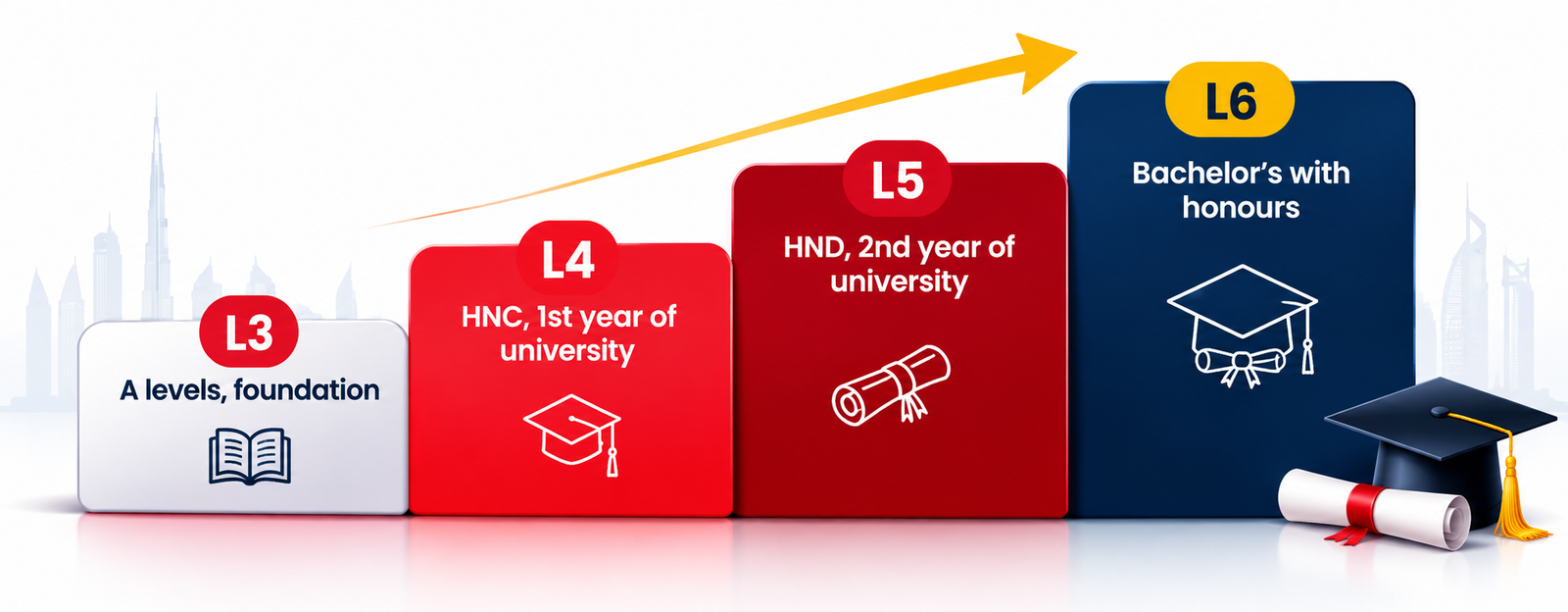
UK qualification levels show how demanding a qualification is, not how long it takes. Level 3 sits at the same stage as A levels, Level 4 at the first year of a UK university and Level 5 at the second year. In the UAE, most students start at Level 3 without Grade 12, or Level 4 with it.

If you’ve been comparing courses in Dubai, you’ve seen labels built on UK qualification levels again and again: “Level 3 Foundation”, “Level 4 Diploma”, “Level 5 Higher International Diploma”. They sound official, and they are. But hardly anyone stops to explain what the numbers mean, or which one you should be looking at.

That gap causes real problems. Students sign up for the wrong level and repeat work they didn’t need to. Parents ask whether a Level 5 is “a degree” and get a different answer from every institute. Working professionals with years of experience assume they have to start at the bottom.

This guide explains Levels 3 to 5 in plain terms. It covers what each level is comparable to, who it’s built for, how long it usually takes, and how far it can take you in the UAE. By the end, you should know which level to start at, and which questions to ask before you enrol anywhere.

What do UK qualification levels actually mean?

UK qualification levels place every regulated qualification on one scale, from entry level to Level 8. The number tells you how demanding the learning is, not how long the course lasts. Two qualifications at the same level ask for a similar depth of knowledge and independence, even if one is a diploma and the other is part of a degree.

The scale is used in England and Northern Ireland, and regulated qualifications are listed on a public register you can search yourself (more on that below). That’s useful in the UAE, where you’ll meet qualifications from many different systems. A level number gives you a fixed point to compare against.

Here’s where Levels 3 to 6 sit, using the UK government’s own examples:

Level UK qualifications at the same level Where UAE students usually meet it
3 A levels, T Levels, advanced apprenticeships, Level 3 diplomas Foundation programs, often for students without a completed Grade 12
4 Certificate of Higher Education, Higher National Certificate (HNC) The first stage of a Higher International Diploma, usually after Grade 12
5 Diploma of Higher Education, foundation degree, Higher National Diploma (HND) Completing a Higher International Diploma
6 Bachelor’s degree with honours A university top-up year after Level 5

“Same level” means same difficulty. It doesn’t mean the qualifications are interchangeable, and it doesn’t decide how a UAE employer or authority will treat them. Keep that distinction in mind, because it comes up again below.

What is a Level 3 diploma, and who is it for?

A Level 3 diploma is a qualification at the same stage as A levels. In the UAE, it’s most often taken as a foundation program by students who haven’t completed Grade 12, or who hold Grade 11 or O Level results. It gives them a structured route into higher-level study.

At ASTI Academy, Level 3 Foundation programs run in engineering, business, hospitality and tourism, and accountancy, on campus or online. They’re much shorter than a diploma, around six months up to 1 year. A foundation program does three jobs at once: it builds the subject basics, teaches the study skills higher levels expect, and opens the door to Level 4.

That last part matters. Level 3 isn’t a lesser option. It’s the level directly below Level 4, so finishing it puts you where a school leaver with Grade 12 would start. See the Level 3 Foundation programs in Dubai for the subjects on offer.

What do Level 4 and Level 5 diplomas cover?

Level 4 and Level 5 diplomas match the depth of the first and second years of a UK university course. Level 4 builds core theory and technical skills in one field. Level 5 moves on to analysis, problem-solving and independent project work. At ASTI Academy, the two are studied together as one Higher International Diploma.

ASTI’s Level 4 and 5 Higher International Diplomas typically run for about two years and carry 240 credits. Fields include:

  • civil, mechanical, electrical, automobile and architectural engineering
  • quantity surveying
  • business management
  • accounting and finance
  • IT
  • psychology
  • health and social care
  • education and training
  • hospitality

Entry is usually straightforward. You need to be 18 or over, hold a recognised high school certificate such as Grade 12, O Levels or A Levels, and meet a basic English requirement. Working professionals can ask about Recognition of Prior Learning (RPL), which is reviewed case by case.

Level 4 or Level 5: where should you start?

Most students in the UAE start at Level 4 if they’ve completed Grade 12, and at Level 3 if they haven’t. You don’t normally choose between Level 4 and Level 5, because a Higher International Diploma takes you through both. Starting directly at Level 5 usually depends on prior study or experience, assessed individually.

Find the row that matches you:

Your situation Typical starting point
Didn’t complete Grade 12, or hold Grade 11 or O Level results Level 3 Foundation
Completed Grade 12, A Levels or equivalent Level 4 and 5 Higher International Diploma
Already hold a relevant Level 4 qualification Level 5, subject to review [VERIFY]
Years of relevant work experience, few formal qualifications RPL review to agree the right entry point
Need one practical skill quickly Professional certification (3–9 months, not a UK-level qualification)

That last row deserves a note. ASTI’s professional certifications in areas such as AI, cybersecurity, HVAC and welding are practical and focused, but they sit outside the UK level system. They’re a good fit when you need a skill for your current job, and a weaker fit when you need a recognised level for progression.

Is a UK Level 5 diploma the same as a degree?

No. A UK Level 5 diploma is at the same level as the first two years of a bachelor’s degree, but it isn’t a degree. Many students use it as a stepping stone: a university can admit Level 5 holders to its final top-up year, and that university then awards the degree.

ASTI Academy delivers the diploma stage; it doesn’t award degrees. Each university sets its own rules on which diplomas it accepts for top-up entry, in the UAE or abroad. So check the university route early rather than after you graduate. Our guide to the diploma-to-degree pathway in the UAE explains how the top-up year works.

Are UK diplomas recognised in the UAE?

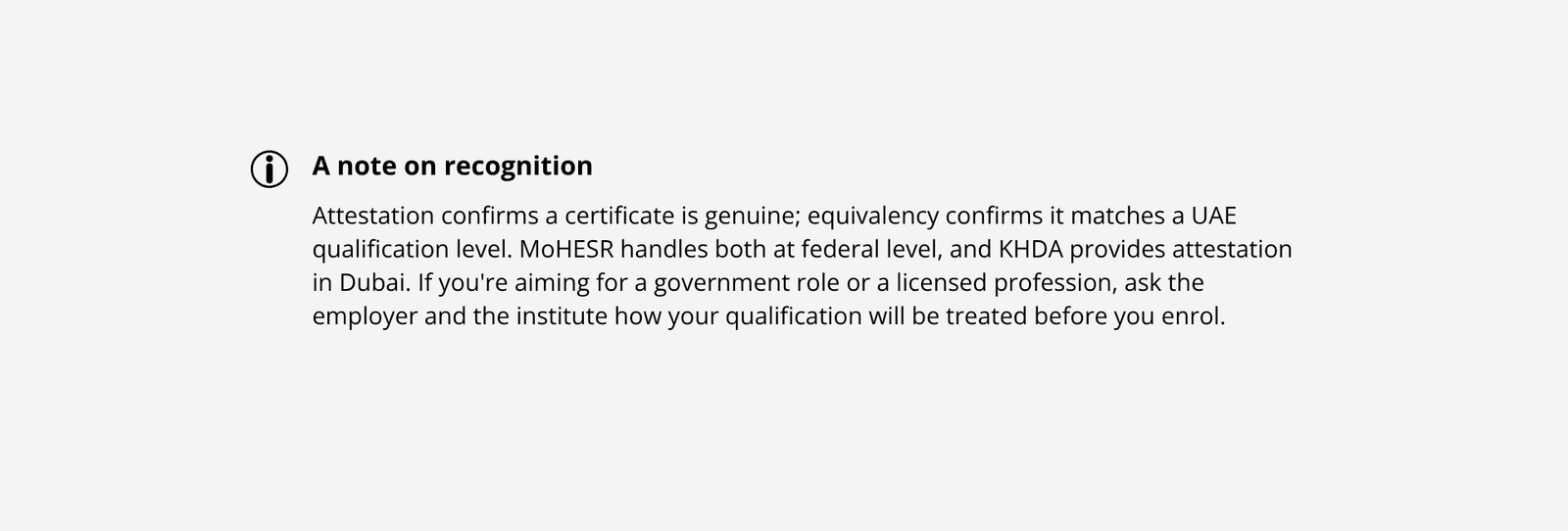
Recognition in the UAE depends on what you need the qualification for. Private-sector employers usually assess qualifications themselves. Government jobs, some regulated professions, and some further-study applications may ask for attestation or an equivalency certificate from the Ministry of Higher Education and Scientific Research (MoHESR).

Two quick checks help:

  1. Confirm the institute is licensed. ASTI Academy is permitted by Dubai’s Knowledge and Human Development Authority (KHDA, Permit 60033).
  2. Ask for the qualification’s exact title and awarding body, then look it up on the UK government’s Register of Regulated Qualifications.

If a provider can’t tell you either, treat that as a warning sign.

Why how you’re taught matters as much as the level

Two diplomas at the same level can still be very different to study. The level sets the standard you have to reach. How you’re taught and assessed decides whether you get there, especially if you’re working or returning after a break.

At ASTI Academy in Dubai, training is fully practical: you spend your time applying ideas in workshops, labs, and real business cases. There are no exams. Every unit is assessed through assignments and project work, so you finish with a portfolio you can show an employer, not just a transcript. We cover this in more depth in how assignment-based grading works on a UK diploma.

Classes run at flexible times, fees can be spread through payment options, and trainers bring industry experience into the room. None of that changes the level. It changes how likely you are to finish it.

Five questions to answer before you choose a level

  1. Did I complete Grade 12 or an equivalent? If not, start at Level 3. If yes, Level 4.
  2. Do I need a UK-level qualification, or just one job skill? For a single skill, a certification may be enough.
  3. Is a degree my long-term goal? If so, check top-up routes before you enrol.
  4. Will I need UAE attestation or equivalency for a government job or licence? Ask early.
  5. Can I commit around two years to a Level 4 and 5 diploma alongside work or family?

If the first three answers are clear, you already know your starting level. The last two shape how and where you study it.

Not sure which level you’d start at?
Share your last certificate with an ASTI Academy advisor and get a straight answer.
Book a free consultation →

Frequently asked questions

What is a Level 3 diploma equivalent to?

In the UK framework, a Level 3 diploma sits at the same level as A levels, T Levels and advanced apprenticeships. That means a similar depth of learning, not an identical qualification. How a Level 3 diploma is treated in the UAE for a specific purpose, such as a job or university application, depends on that employer or institution.

Can I start a Level 4 diploma straight after Grade 12?

Yes, usually. Applicants aged 18 or over with a recognised high school certificate, such as Grade 12, O Levels or A Levels, and basic English can normally start a Level 4 and 5 Higher International Diploma. Students who haven’t completed Grade 12 typically begin with a Level 3 foundation program instead.

How long does it take to go from Level 3 to Level 5?

At ASTI Academy, a Level 3 Foundation program takes around six months, and a Level 4 and 5 Higher International Diploma typically takes about two years. Starting from Level 3, most students should plan for roughly two and a half years in total, depending on the program and study mode.

Do UK Level 3 to 5 diplomas at ASTI have exams?

No. ASTI Academy assesses its UK Level 3 to 5 diplomas through assignments and project work instead of exams. You work through each unit, submit practical tasks, and build a portfolio. That suits students who are working, returning to study, or who show their skills better through applied work.

Can I study a UK diploma while working in Dubai?

Yes, many students do. ASTI Academy offers flexible class timings, on-campus, online, and blended study options depending on the program, and payment plans. Because assessment is by assignment rather than fixed exam dates, it’s easier to plan coursework around shifts, travel, and family commitments.

Your next step

UK qualification levels are far less confusing once you see them as a staircase. Level 3 gets you ready, and Level 4 builds the foundations of your field. Level 5 takes you to the point where you can work at a higher level or step into a university’s final year. The right starting point depends on what you’ve already finished, not on how long ago you finished it.

If you’d like a second opinion on where you fit, an ASTI Academy advisor can look at your certificates and goals and suggest a level and study mode. There’s no pressure to decide on the spot.

Explore UK diploma programs · Talk to an admissions advisor

Close Menu